Jacky
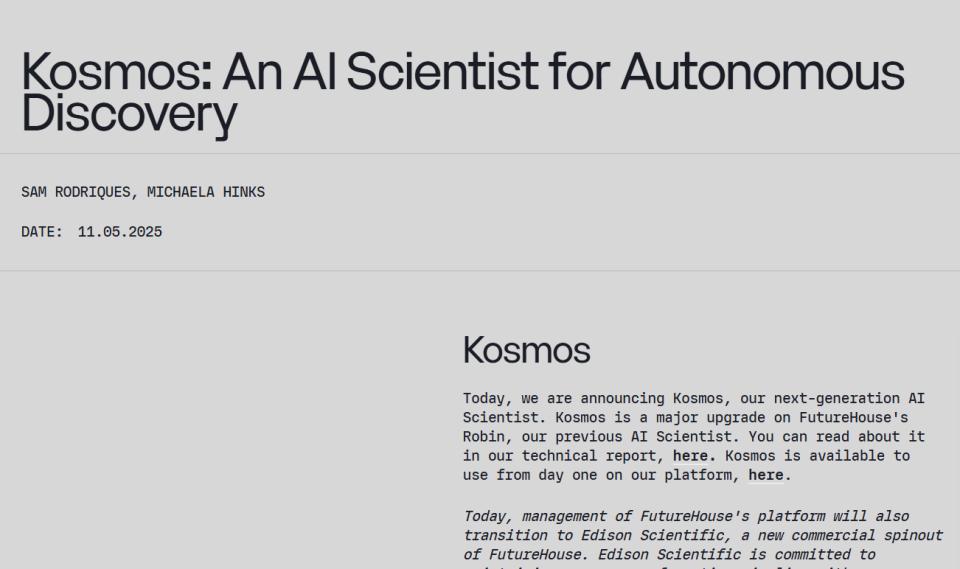
AI super-scientist Kosmos completes half a year’s worth of human research in just 12 hours, with an accuracy rate of 79.4%. The non-profit research institution FutureHouse recently unveiled an AI super-scientist system named “Kosmos.” A single run of this system can accomplish a research workload equivalent to that of a human research team over half a year in just 12 hours.
Sam Altman, CEO of OpenAI, commented on this, saying, “This is incredibly exciting! I anticipate that we will see more similar projects in the future, and this will be one of the most important application directions for artificial intelligence.” The AI scientist “Robin,” developed by FutureHouse in its early stages, had significant limitations, particularly in handling vast amounts of information. Due to the context length limitations of language models at the time, it struggled to achieve multi-level logical reasoning during the inference process, directly impacting the depth and complexity of its scientific discoveries.
Kosmos’s major breakthrough stems from its adoption of a “Structured World Model.” This architectural innovation enables the system to efficiently integrate information from the trajectories of hundreds of intelligent agents, maintaining a high degree of alignment with core research objectives even when processing massive datasets on the scale of tens of millions of tokens. Kosmos employs an autonomous cyclic working architecture that can initiate literature retrieval and data analysis tasks in parallel, continuously update its internal knowledge graph, and intelligently plan the direction for the next round of exploration.
According to statistics, on average, Kosmos completes 166 rounds of data analysis and 36 iterations of literature review in a single run. All conclusions can be traced back to specific code snippets or original sources, supporting complete audit verification. During a continuous 12-hour operation, the system can read 1,500 academic papers, generate and execute 42,000 lines of analysis code, and output a complete, traceable research report. Its comprehensive processing capabilities have surpassed all known intelligent agent systems to date.
Evaluate whether the relationship remains user-led
Notifications, progression and premium features should support the user’s chosen interaction rather than manufacture urgency. Quiet hours, frequency controls and easy cancellation are practical signs that the product respects the user’s pace.
Compare richer media with the core conversation
Voice, images and video are valuable when they reinforce the same identity. If media quality is inconsistent or arrives too slowly, a simpler response may produce a better overall experience.
Test the product over more than one session
A first conversation can show personality, but long-term quality appears only after the system has accumulated memory, preferences and notifications. Return later, change a preference and see whether the companion adapts without losing its core identity. Longitudinal testing also exposes repetition and stale context that a short demo cannot reveal.
Use controls as part of the quality test
Try the memory, notification, privacy and reset controls before you need them. A strong companion should make important settings understandable without forcing the user to delete the entire relationship to repair one problem. The best experience becomes more relevant over time while remaining easy to correct.
Look for continuity without constant callbacks
A companion should use remembered context when it helps, not repeatedly announce that it remembers. Good continuity reduces the need for the user to restate important information and makes recurring activities easier to resume. If every response references old history, personalization can feel forced rather than natural.
Check how the system handles a mistake
Correct a fact, reject a suggestion or change topic abruptly. The companion should repair the interaction and update the relevant state instead of arguing or repeating the same assumption later.
A final long-term check
Repeat the same test after several days and after changing one setting. AI products accumulate memory, synchronization state and billing or permission history, so problems may appear only after the first-session novelty has passed. The strongest products remain understandable as history grows: users can see what changed, correct the relevant state and continue without rebuilding the entire relationship.


 admin