Jacky
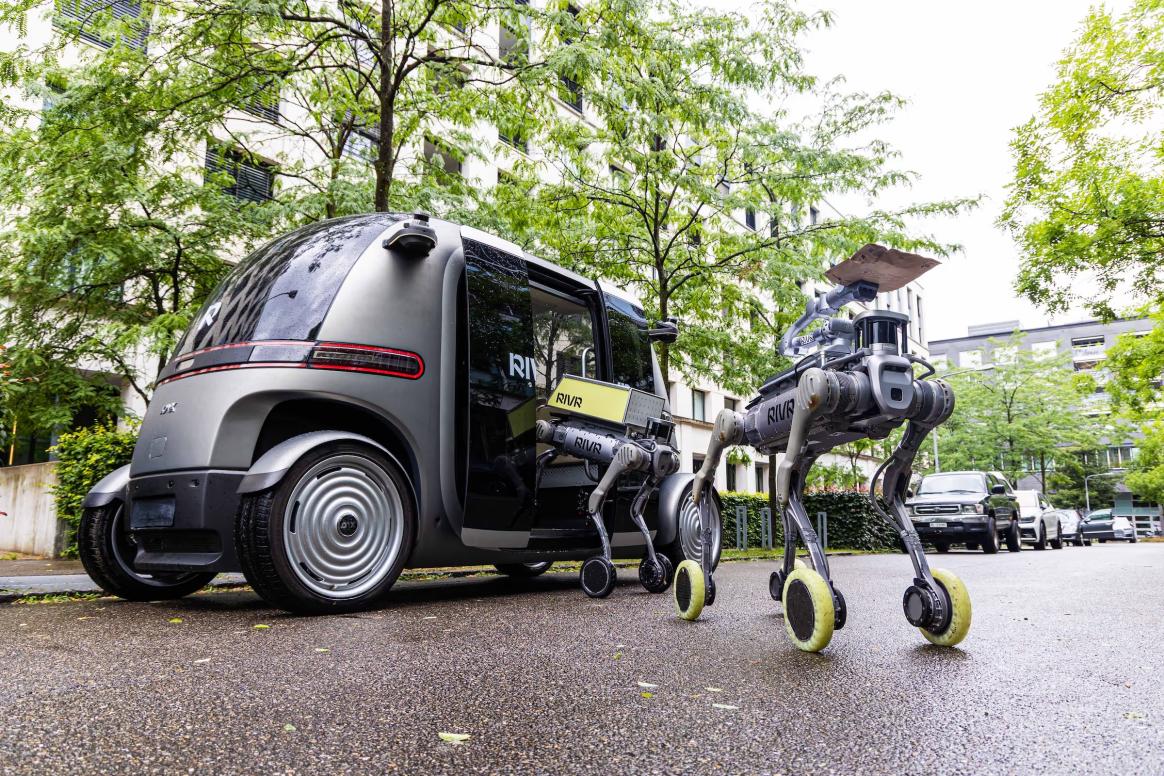
Founded in 2023 as a spin-off from ETH Zurich, RIVR Technologies develops next-gen legged-wheel delivery robots powered by physical AI, enabling them to autonomously navigate urban obstacles like stairs, curbs, and doors—solving the tricky “last 100 meters” of logistics.
The founding team brings deep robotics expertise from ETH Zurich’s Robotic Systems Lab, led by CEO Marko Bjelonic (PhD), with key roles held by experts in software, hardware, and operations.

Unlike traditional wheeled or drone delivery solutions, RIVR’s robots combine reinforcement learning (simulated training) and supervised learning (real-world data) to master complex environments. Their hybrid mobility design—wheels for speed on flat ground, legs for overcoming obstacles—delivers 5x longer battery life, 10x wider coverage, and faster speeds than conventional legged bots.
Equipped with LiDAR, cameras, and AI-powered navigation, each robot can carry 40L of goods, travel 30km per charge at 15km/h, and operate in all weather. With a 90% on-time delivery rate, €0.40/km operating cost, and 18-month ROI, RIVR’s robots are already partnering with Just Eat, Evri, Veho, Swiss Post, and Migros Online to optimize last-mile logistics.
Test the product over more than one session
A first conversation can show personality, but long-term quality appears only after the system has accumulated memory, preferences and notifications. Return later, change a preference and see whether the companion adapts without losing its core identity. Longitudinal testing also exposes repetition and stale context that a short demo cannot reveal.
Use controls as part of the quality test
Try the memory, notification, privacy and reset controls before you need them. A strong companion should make important settings understandable without forcing the user to delete the entire relationship to repair one problem. The best experience becomes more relevant over time while remaining easy to correct.
Look for continuity without constant callbacks
A companion should use remembered context when it helps, not repeatedly announce that it remembers. Good continuity reduces the need for the user to restate important information and makes recurring activities easier to resume. If every response references old history, personalization can feel forced rather than natural.
Check how the system handles a mistake
Correct a fact, reject a suggestion or change topic abruptly. The companion should repair the interaction and update the relevant state instead of arguing or repeating the same assumption later.
Evaluate whether the relationship remains user-led
Notifications, progression and premium features should support the user’s chosen interaction rather than manufacture urgency. Quiet hours, frequency controls and easy cancellation are practical signs that the product respects the user’s pace.
Compare richer media with the core conversation
Voice, images and video are valuable when they reinforce the same identity. If media quality is inconsistent or arrives too slowly, a simpler response may produce a better overall experience.
A final long-term check
Repeat the same test after several days and after changing one setting. AI products accumulate memory, synchronization state and billing or permission history, so problems may appear only after the first-session novelty has passed. The strongest products remain understandable as history grows: users can see what changed, correct the relevant state and continue without rebuilding the entire relationship.


 admin