Jacky
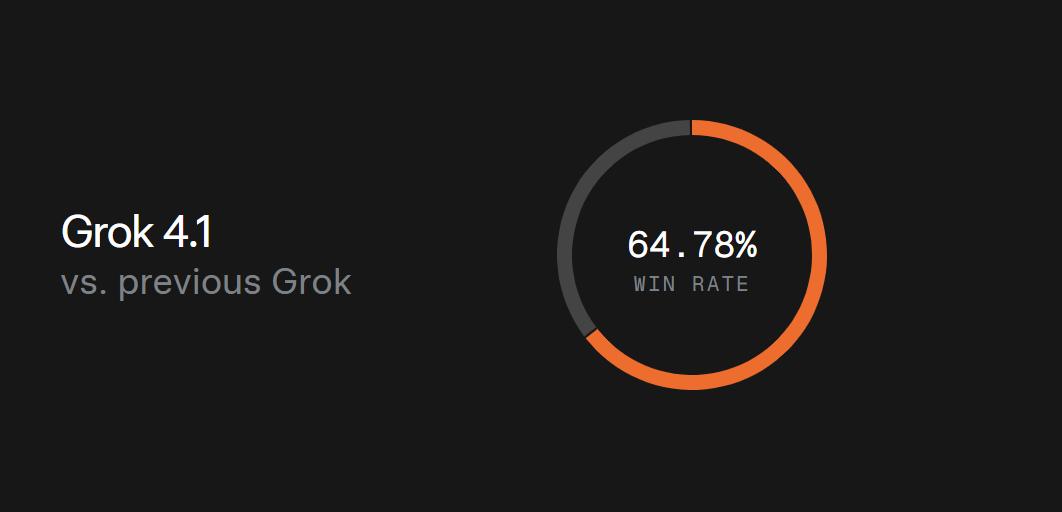
The AI throne has changed hands overnight! Early in the morning, Elon Musk, with his company xAI, dropped a bombshell—Grok 4.1 was officially launched and made available to everyone for free.
Interestingly, Grok 4.1 also emphasizes having both high “IQ and EQ,” directly taking on GPT-5.1. This time, Grok 4.1 comes in two major versions: Grok 4.1 Thinking and Grok 4.1.
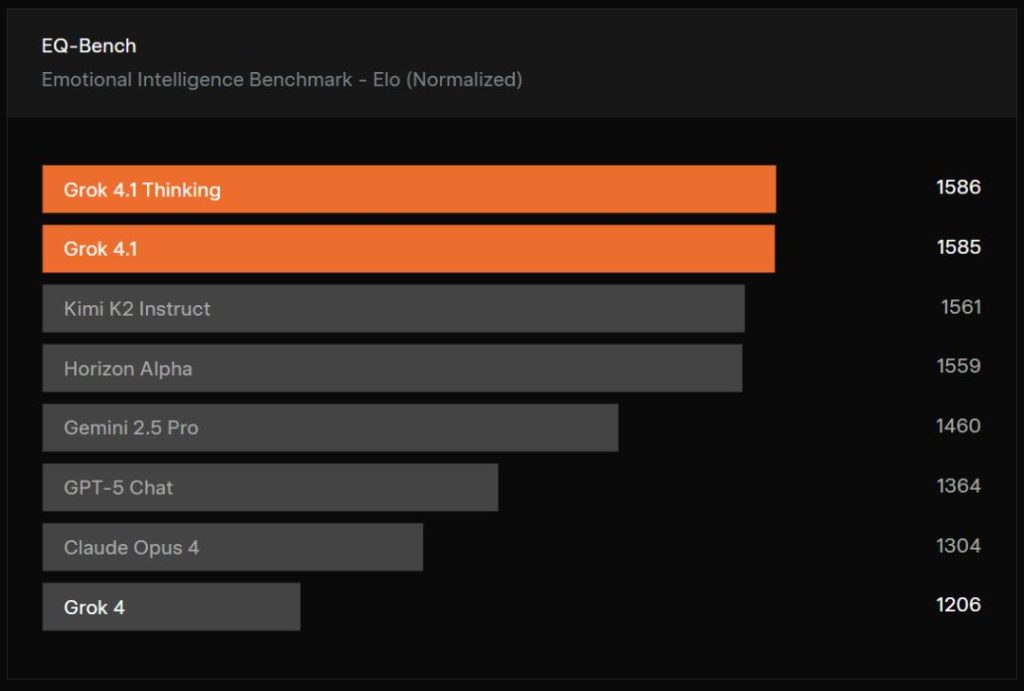
On the LMArena leaderboard, Grok 4.1 Thinking scored an impressive 1483 Elo, claiming the title of the world’s top large language model with absolute dominance. The Thinking version is a full 31 points higher than Gemini 2.5 Pro. Even the non-reasoning mode of Grok 4.1 directly surged to second place on the list. Not only that, Grok 4.1 also boasts exceptional emotional intelligence, with higher emotional awareness, empathy, and interpersonal interaction capabilities. It topped the EQ-Bench with a score of 1586 Elo.
In terms of writing, Grok 4.1 (1722) saw a 600-point Elo increase compared to its predecessor. Moreover, its hallucination rate plummeted by three times compared to previous models. The rapid evolution of Grok 4.1 can be attributed to the xAI team’s decision to expand the scale of Reinforcement Learning (RL) in the post-training phase by an order of magnitude.
It’s truly unexpected that before Google’s Gemini 3.0 arrives, Musk has made a major move.
Look for continuity without constant callbacks
A companion should use remembered context when it helps, not repeatedly announce that it remembers. Good continuity reduces the need for the user to restate important information and makes recurring activities easier to resume. If every response references old history, personalization can feel forced rather than natural.
Check how the system handles a mistake
Correct a fact, reject a suggestion or change topic abruptly. The companion should repair the interaction and update the relevant state instead of arguing or repeating the same assumption later.
Evaluate whether the relationship remains user-led
Notifications, progression and premium features should support the user’s chosen interaction rather than manufacture urgency. Quiet hours, frequency controls and easy cancellation are practical signs that the product respects the user’s pace.
Compare richer media with the core conversation
Voice, images and video are valuable when they reinforce the same identity. If media quality is inconsistent or arrives too slowly, a simpler response may produce a better overall experience.
Test the product over more than one session
A first conversation can show personality, but long-term quality appears only after the system has accumulated memory, preferences and notifications. Return later, change a preference and see whether the companion adapts without losing its core identity. Longitudinal testing also exposes repetition and stale context that a short demo cannot reveal.
Use controls as part of the quality test
Try the memory, notification, privacy and reset controls before you need them. A strong companion should make important settings understandable without forcing the user to delete the entire relationship to repair one problem. The best experience becomes more relevant over time while remaining easy to correct.
A final long-term check
Repeat the same test after several days and after changing one setting. AI products accumulate memory, synchronization state and billing or permission history, so problems may appear only after the first-session novelty has passed. The strongest products remain understandable as history grows: users can see what changed, correct the relevant state and continue without rebuilding the entire relationship.


 admin