Jacky
Jacky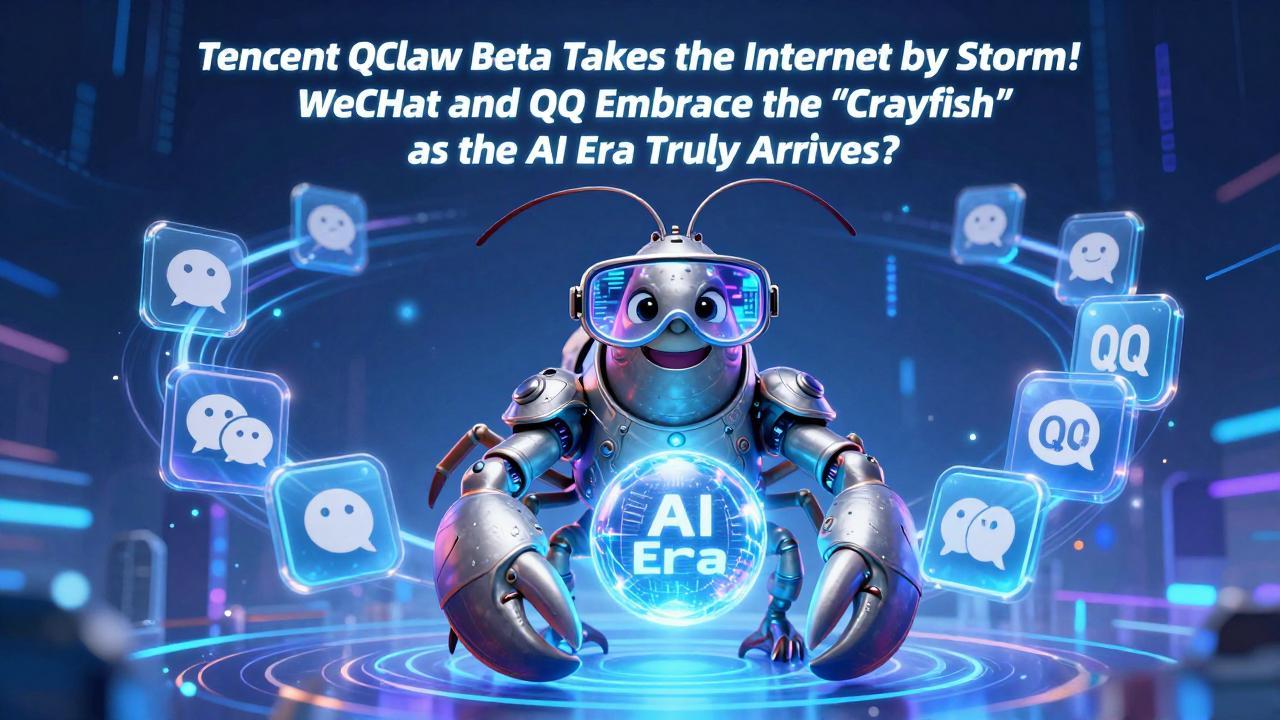
Recently, the tech world has been buzzing with significant news: Tencent has launched the beta testing for QClaw, successfully integrating with both WeChat and QQ, and incorporating the popular open-source AI agent OpenClaw (playfully nicknamed “Crayfish” by netizens). This is far more than a routine product update; it marks a critical signal that AI is finally breaking out of the tech niche and moving towards universal adoption. It also heralds a new phase for the AI industry, moving beyond conceptual hype and into large-scale practical implementation.
By embedding AI capabilities directly into national-level social networking gateways, an intelligent transformation affecting everyone’s life and work has well and truly begun.
Barriers Reduced to Zero! QClaw Brings AI to Everyday Chat Boxes
Many might be wondering what QClaw actually is. In essence, it’s a lightweight productized version of OpenClaw, designed to solve the core problem of making AI accessible for ordinary people. There’s no need to understand code or set up complex environments; simply download a local installation package for one-click deployment. It’s also compatible with multiple domestic AI models and supports custom models – zero difficulty.
Its most groundbreaking feature is the seamless integration with WeChat and QQ. For the first time, these social platforms, boasting billions of users, provide a high-frequency, everyday setting for AI agents. Users can now give simple commands directly within a chat window, instructing the AI to handle tasks like organizing files, generating meeting minutes, or summarizing information.
With this move, Tencent has completely shattered the barriers to AI usage, transforming it from an exclusive “black tech” for enthusiasts into a daily tool accessible to everyone. This also underscores the core future of AI: ease of use, accessibility, and practical implementation.
Major Trends in the AI Industry for 2026: 3 Core Trends Shaping the Future Landscape
The Tencent QClaw beta is just one microcosm of the broader AI industry explosion. Putting aside complex technical data, the current development trajectory of the AI industry is clear, with three major trends directly defining its future direction.
Trend 1: The Rise of AI Agents – From Passive Responders to Proactive Doers
2026 is being called the “Year of the AI Agent” by industry insiders. Previously, AI could only passively execute commands. Now, it is evolving into “digital assistants” capable of independently completing tasks and even collaborating with multiple agents. Whether as personal life assistants or enterprise productivity tools, agents are steadily becoming the core of efficiency gains. In the future, they will be deeply integrated into all walks of life.
Trend 2: Vertical Specialization Becomes Mainstream, Multimodality is Standard
The frenzy over large language models from a couple of years ago has subsided. The AI industry is no longer blindly competing over parameter counts or showcasing raw computing power. Instead, the focus has shifted to deep specialization in vertical fields like healthcare, manufacturing, finance, and e-commerce, solving real problems within practical contexts.
Simultaneously, multimodal AI, capable of processing text, images, audio, and video concurrently, is becoming an industry standard. AI is no longer confined to text-based interaction; it can better adapt to real-world scenarios, leading to more precise and practical applications.
Trend 3: Security & Compliance as Foundation, Business Models Lean Towards Lightweight
As AI permeates critical sectors like finance and healthcare, security governance is no longer an add-on but a matter of life and death for the industry. Compliant implementation has become a basic requirement for AI products, steering the industry away from野蛮生长 (reckless expansion) towards standardized development.
In terms of business models, “pay-as-you-go” and lightweight usage are becoming mainstream. Small and medium-sized enterprises can now utilize AI tools without massive upfront investment, truly allowing the benefits of AI to reach the entire market and achieve inclusive development.
AI for Everyone – Social Media is Just the Starting Point for AI Implementation
Tencent integrating AI into WeChat and QQ is merely the first step in AI’s popularization. In the future, AI will not be confined to social scenarios. It will comprehensively permeate all areas of life, work, and industry, becoming a foundational utility like electricity and water, reshaping daily efficiency and industrial structures.
Final Thoughts
The beta launch of Tencent’s QClaw has sounded the bell for the era of AI for everyone. AI is no longer a distant, unreachable technology but a practical tool within arm’s reach. Whether for individuals or businesses, proactively embracing AI and leveraging it to enhance efficiency is the optimal strategy for seizing the dividends of this new era.