Jacky
Jacky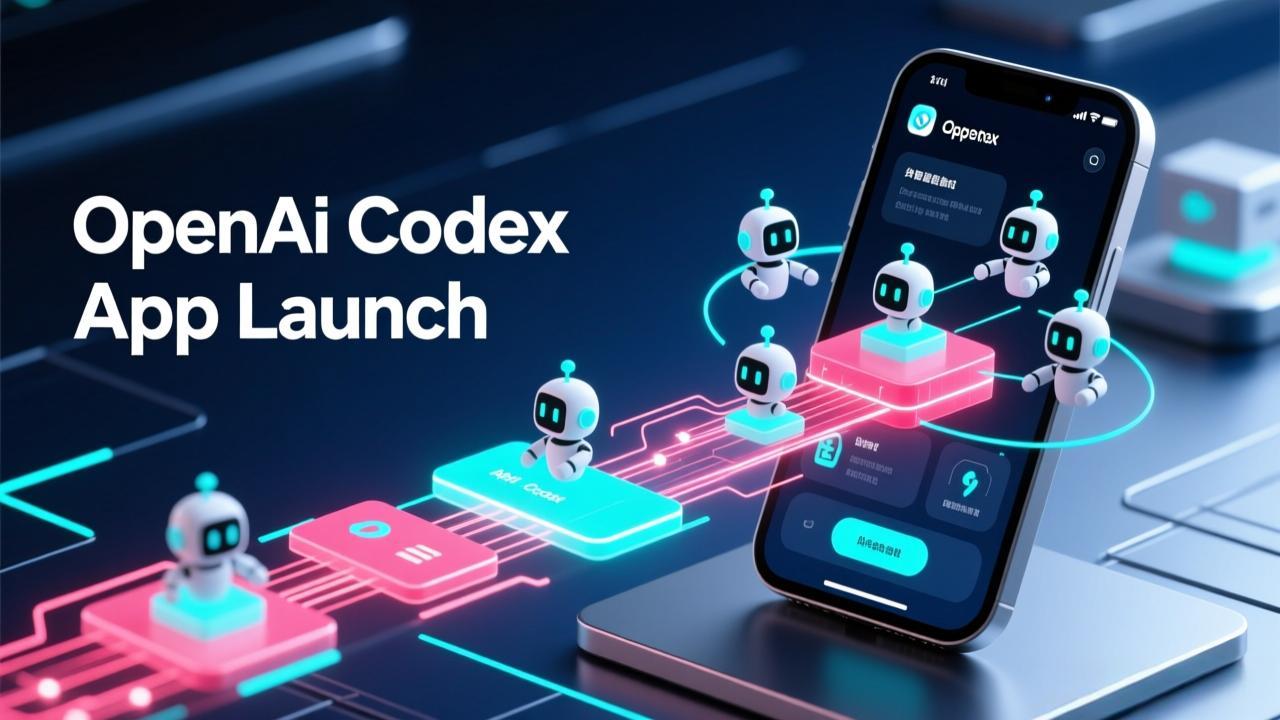
On February 2nd (local time), OpenAI officially announced the launch of the Codex app, which is now available on macOS, with a Windows version confirmed to be coming soon. This move further improves its AI programming ecosystem layout and promotes the transformation of multi-agent collaborative work from technical exploration to practical implementation [36 Kr, February 3, 2026]. As a core upgrade of OpenAI in the field of programming agents, this app relies on three core capabilities—multi-agent parallelism, reusable skill modules, and automated workflows—to bridge the gap between cutting-edge AI model capabilities and actual development scenarios, reshaping the efficiency of the entire software development process.
Core Breakthroughs: Three Capabilities Solve Pain Points in AI Programming Collaboration
Prior to this, OpenAI has continuously iterated in the field of AI programming. From the launch of the private beta version of Codex API in 2021, to the introduction of Codex CLI and cloud-based AI programming agents in 2025, and the optimization of GPT-5-Codex model, it has gradually enhanced the code generation and task processing capabilities of agents [Douyin Encyclopedia, December 16, 2025]. However, existing Integrated Development Environments (IDEs) and terminal tools are difficult to support large-scale collaboration of multiple agents, becoming a key bottleneck restricting efficiency improvement [Zhidx.com, February 3, 2026]. The newly launched Codex app is a targeted solution to this pain point.
Capability 1: Multi-Agent Parallelism with Worktree Isolation to Avoid Conflicts
The Codex app builds an exclusive agent space, supporting developers to use multiple agents in parallel. Through worktree isolation technology, different agents can work independently in the same code repository, effectively avoiding modification conflicts [36 Kr, February 3, 2026]. Each agent runs on an isolated copy of the code, which not only allows exploring different development paths but also eliminates the need to track impacts on the overall codebase. Developers can view the modification records of agents locally or manually intervene in editing without changing the local git state [Zhidx.com, February 3, 2026].
This design solves the core problem of multi-agent collaboration—developers can seamlessly switch tasks without losing context, and supervise multiple agents to promote the full-lifecycle work across design, construction, release, and maintenance [Zhidx.com, February 3, 2026]. It is reported that since the launch of the GPT-5.2-Codex model in mid-December 2025, the overall usage of Codex has doubled, demonstrating the market demand for multi-agent programming capabilities [Zhidx.com, February 3, 2026].
Capability 2: Modular Encapsulation of Skills for Cross-Scenario Reuse
The Codex app breaks the functional boundaries of traditional AI programming tools, evolving from simple code generation to an agent capable of completing various computer-based tasks, with the core lying in the design of the “skill” module [Zhidx.com, February 3, 2026]. Developers can package tools and specifications into reusable skill modules, covering core elements such as instructions, resources, and scripts, realizing the integration of tool connection, workflow operation, and personalized task execution [36 Kr, February 3, 2026].
The app has a built-in dedicated interface for skill creation and management. Developers can manually assign specific skills to agents or let them automatically match based on task requirements [Zhidx.com, February 3, 2026]. Currently, OpenAI has built hundreds of skills internally, covering multiple scenarios such as UI code generation, project management, cloud deployment, image generation, and document creation. For example, it can obtain design resources from Figma and convert them into production-level UI code, or deploy web applications to cloud platforms such as Cloudflare and Netlify [Zhidx.com, February 3, 2026]. More notably, Codex once independently completed a racing game with multiple cars, maps, and a prop system using more than 7 million tokens based solely on initial prompts, undertaking design, development, and QA testing functions [Zhidx.com, February 3, 2026].
Capability 3: Automated Workflows to Free Up Repetitive Labor
For repetitive tasks in the development process, the Codex app supports building background scheduled workflows, allowing agents to handle mechanical tasks such as daily issue screening, CI failure summary, release briefing generation, and error checking [Zhidx.com, February 3, 2026]. Automated tasks can combine instructions and skill modules to run according to pre-designed plans. After completion, the results are sent to the review queue, and developers can intervene in subsequent work on demand, realizing an efficient model of “AI-led + manual review” [Zhidx.com, February 3, 2026].
In addition, the Codex app supports switching between two personality styles. Developers can use the /personality command to choose between a concise and pragmatic style or a conversational empathetic style, adapting to different work scenario needs [Zhidx.com, February 3, 2026]. In terms of security, the app adopts the same native open-source sandbox mechanism as Codex CLI, which by default restricts agents to editing files only within the working folder. Operations requiring elevated permissions need to be actively requested, and developers can customize team permission rules [Zhidx.com, February 3, 2026].
Ecosystem Extension: Full Platform Coverage + User Benefit Upgrades
This time, the Codex app was first launched on macOS, and the subsequent launch of the Windows version will achieve full coverage of mainstream desktop systems, further expanding user reach [36 Kr, February 3, 2026]. At the same time, OpenAI launched a limited-time benefit: the Codex app is open to ChatGPT free version and Go subscription users, while paid users such as Plus, Pro, and Business versions can get a double call rate increase, covering the app, CLI, IDE extensions, and the entire cloud platform [Kuailansi 24-Hour Financial Live Broadcast, February 3, 2026].
In terms of ecological collaboration, the Codex app can synchronize the session history and configurations of Codex CLI and IDE extensions, and seamlessly connect with GitHub. Combined with previously launched Slack integration, Codex SDK, and background management tools, it forms a full-scenario programming assistance system of “Terminal + IDE + Desktop App + Cloud” [Douyin Encyclopedia, December 16, 2025]. Data shows that as of October 2025, Codex has processed 40 terabytes of tokens, becoming one of OpenAI’s fastest-growing products. Its performance surpassed competitors such as Claude 3.7 with an accuracy rate of 72.1% in the SWE-bench test [Douyin Encyclopedia, December 16, 2025].
Industry Impact: AI Programming Enters the “Era of Multi-Agent Collaboration”
The launch of the Codex app not only improves OpenAI’s own AI programming ecosystem but also promotes the transformation of the entire software development industry. Previously, most AI programming tools focused on code generation for single tasks, while Codex has achieved a leap from “assisted coding” to “full-process collaboration” through multi-agent collaboration, skill reuse, and automated workflows [Zhidx.com, February 3, 2026].
For developers, Codex can reduce coding time by an average of 30% and improve the efficiency of repetitive tasks by more than 10 times, freeing developers from mechanical labor to focus on core work such as demand analysis and architectural design [Douyin Encyclopedia, December 16, 2025]. For enterprises, Codex’s SDK supports integration with existing enterprise workflows, and background management tools can track usage throughout the process, adapting to team collaboration scenarios and lowering the threshold for the implementation of AI programming [Douyin Encyclopedia, December 16, 2025].
However, AI programming still has limitations. Codex still requires human intervention in scenarios such as complex system architecture design and cross-module coordination. At the same time, issues such as copyright risks and security vulnerabilities of generated code need continuous improvement [Douyin Encyclopedia, December 16, 2025]. OpenAI stated that it will continue to optimize multi-agent workflows, launch faster reasoning functions, and build cloud-triggered automation capabilities to achieve continuous background operation even when the computer is shut down [Zhidx.com, February 3, 2026].
With the landing and iteration of the Codex app, the integration of AI and software development will be further deepened. The collaborative model of “human developers + AI agent teams” may become the industry mainstream, driving software development into a more efficient and intelligent new stage.
References:
1. 36 Kr, “OpenAI Launches Codex App, Supporting Multi-Agent Parallel Work”, February 3, 2026
2. Zhidx.com, “Free! OpenAI Launches Codex App Late at Night to Command Multiple Agents to Work”, February 3, 2026
3. Douyin Encyclopedia, “Codex (Software Engineering Agent)”, December 16, 2025
4. Kuailansi 24-Hour Financial Live Broadcast, “OpenAI Launches Codex App, Open to Multiple Types of Users”, February 3, 2026