Jacky
Jacky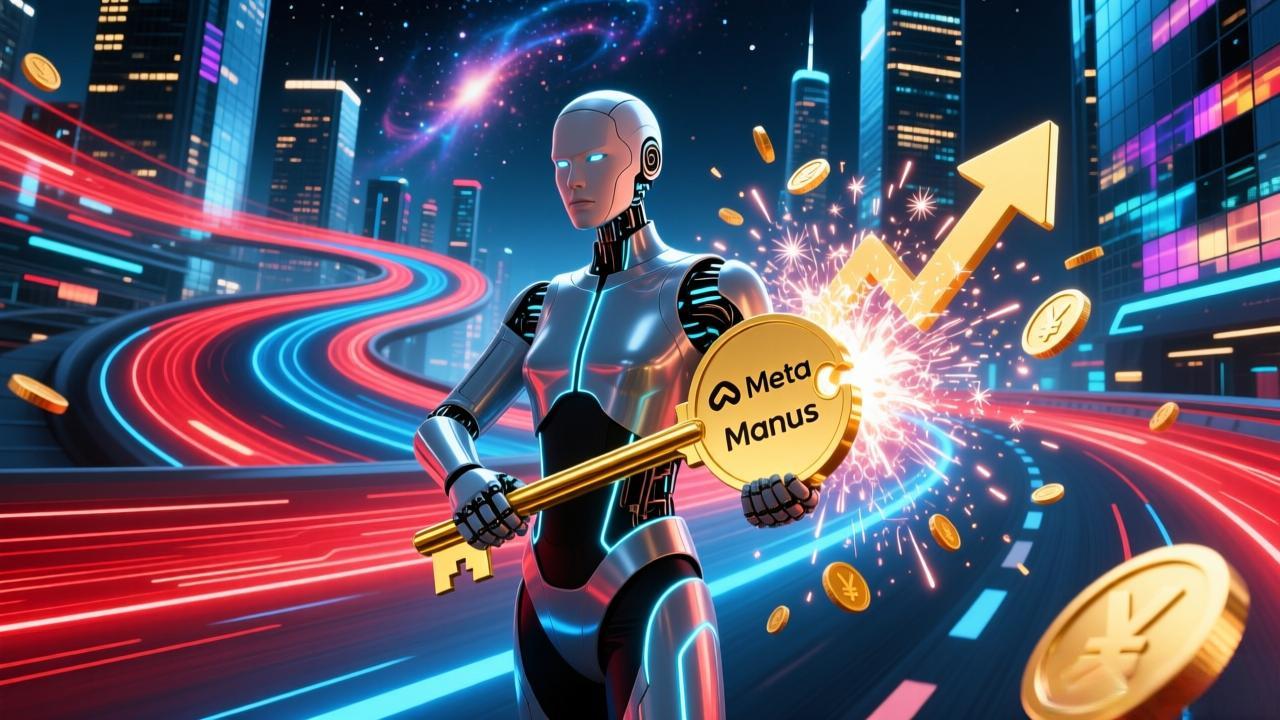
Recently, a bombshell announcement shook the tech world: Meta declared it would acquire Manus, a general-purpose AI agent developed by a Chinese startup, for $2 billion. This not only sets a new record for the highest valuation of a Chinese AI team acquired by a foreign giant but also marks a milestone for the AI digital human agent sector—shifting from a conceptual stage to an era of global capital frenzy.
From its launch in March 2025 to being absorbed by Meta, Manus transformed from an “industry dark horse” to a “capital darling” in just nine months. Without the halo of prestigious overseas universities or backing from big tech executives, this Chinese team has rewritten the competitive landscape of the global AI agent industry with a disruptive product.
Behind the $2 Billion Deal: What Makes Manus Irresistible to Meta?
Amid the serious homogenization of AI large language models (LLMs), Manus’ core competitiveness lies in breaking the dilemma of traditional AI being “all talk and no action.” Unlike purely conversational AI, this world’s first general-purpose AI agent truly achieves “integration of thinking and action”—it can independently plan, call tools, execute operations upon receiving a task, and ultimately deliver a complete result directly.
Its technical strength has long been verified: in the authoritative GAIA benchmark test, Manus achieved SOTA (State-of-the-Art) results, with its complex task processing capability 23.7% higher than similar products from OpenAI. More crucially, it adopts a unique Multiple Agent architecture, where planning agents, execution agents, and verification agents work collaboratively in an independent virtual machine. It can handle both enterprise tasks such as resume screening and stock analysis, and personal needs like travel planning and PPT creation, with a per-task cost only one-tenth of the industry average.
Such product strength enabled Manus to complete a $75 million Series B financing just one month after its launch, pushing its valuation to nearly $500 million. By the time of the acquisition, its revenue had exceeded $100 million, with millions of users worldwide. For Meta, which is eager to seize the initiative in the AI agent field, acquiring Manus not only secures core technologies but also provides direct access to a mature product ecosystem—making this deal a “win-win” for both parties.
Behind Capital Frenzy: The $100 Billion Blue Ocean of the AI Agent Track
The sky-high acquisition of Manus is by no means an isolated incident but a microcosm of global capital layout in the AI agent track. Data shows that in 2025, there were 9 billion-dollar AI acquisition deals initiated by global tech giants, half of which focused on the agent sector. According to market forecasts, the global AI agent market size will jump from $5.1 billion in 2024 to $47.1 billion in 2030, with a compound annual growth rate (CAGR) of 44.8%.
Capital enthusiasm stems from the disruptive value of agent technology to industries. If LLMs are the “brain” of the AI era, then AI agents are “complete living organisms” capable of independent action—they can break down “data silos” within enterprises, enabling instant scheduling of 10-million-level orders; replace manual repetitive work, saving white-collar workers an average of 2.3 hours per day; and penetrate vertical fields such as healthcare, finance, and manufacturing, achieving upgrades like improved early cancer detection rates and doubled credit review efficiency.
In China, the popularity of this track is also soaring. The State Council’s “Opinions on Further Implementing the ‘AI+’ Action” clearly states that the penetration rate of agent applications should exceed 70% by 2027. Lenovo’s “Luban” agent and Baidu’s multi-agent system have been deployed in factories and urban governance; companies like 01.AI have even defined 2026 as the “first year of large-scale on-the-job enterprise multi-agents.” From policies to industries, from giants to startups, a complete agent ecosystem is taking shape.
Enlightenment for Chinese AI Teams: Internationalization is the Larger Stage
Manus’ success offers profound insights for Chinese AI entrepreneurs. ZhenFund, its angel investor, commented bluntly: “Starting from a residential building without any halos, this team has created a product that is respected by global manufacturers.” More importantly, Manus adopted an international strategy from its inception, with product architecture and service capabilities fully oriented to global users. This is what attracted Meta’s attention, leading to a valuation dozens of times higher than that of AI companies focusing solely on the local market.
As Li Jinxiang, founder of Enniu Data, put it: “AI knows no borders. For Chinese entrepreneurs, taking the world as their stage will bring more opportunities.” Mature overseas payment habits, a larger user base, and more diverse capital exit channels have made internationalization an inevitable choice for AI startups. The acquisition of Manus also proves that the technical strength of Chinese AI teams has been globally recognized—Chinese engineers are becoming a core force in the global AI field.
Caution Amid Frenzy: Challenges and Prospects of AI Agents
Despite the ongoing capital frenzy, we must clearly recognize the challenges facing the AI agent track. Technically, some agents still rely on third-party LLMs, with shortcomings in long-context processing capabilities, and virtual machine security vulnerabilities urgently need to be addressed. Commercially, the marginal cost advantage in some scenarios is not yet obvious, and large-scale implementation still requires breakthroughs. Ethically, issues such as liability definition and data security brought about by independent decision-making require the industry to establish unified standards.
Undeniably, however, the era of AI agents has arrived. From Meta’s $2 billion acquisition to large-scale industrial deployment, the “iPhone moment” for this track may be approaching. As agents evolve from “tools” to “digital employees” and from “individual intelligence” to “group collaboration,” our work and lifestyle will be redefined.
Meta’s acquisition of Manus has drawn a shocking end to the global AI industry in 2025 and kicked off the agent track in 2026. Capital inflows, technological breakthroughs, and industrial demand will jointly drive this AI revolution into deeper waters. And Chinese AI teams are writing their own brilliant chapters in this global competition.
「Today’s Interaction」Which job do you think AI agents will replace first? Welcome to leave your thoughts in the comments!
This article is an original work by Tech Insight. Reproduction is permitted only with authorization.
▼ Follow us to understand cutting-edge tech trends