Jacky
Jacky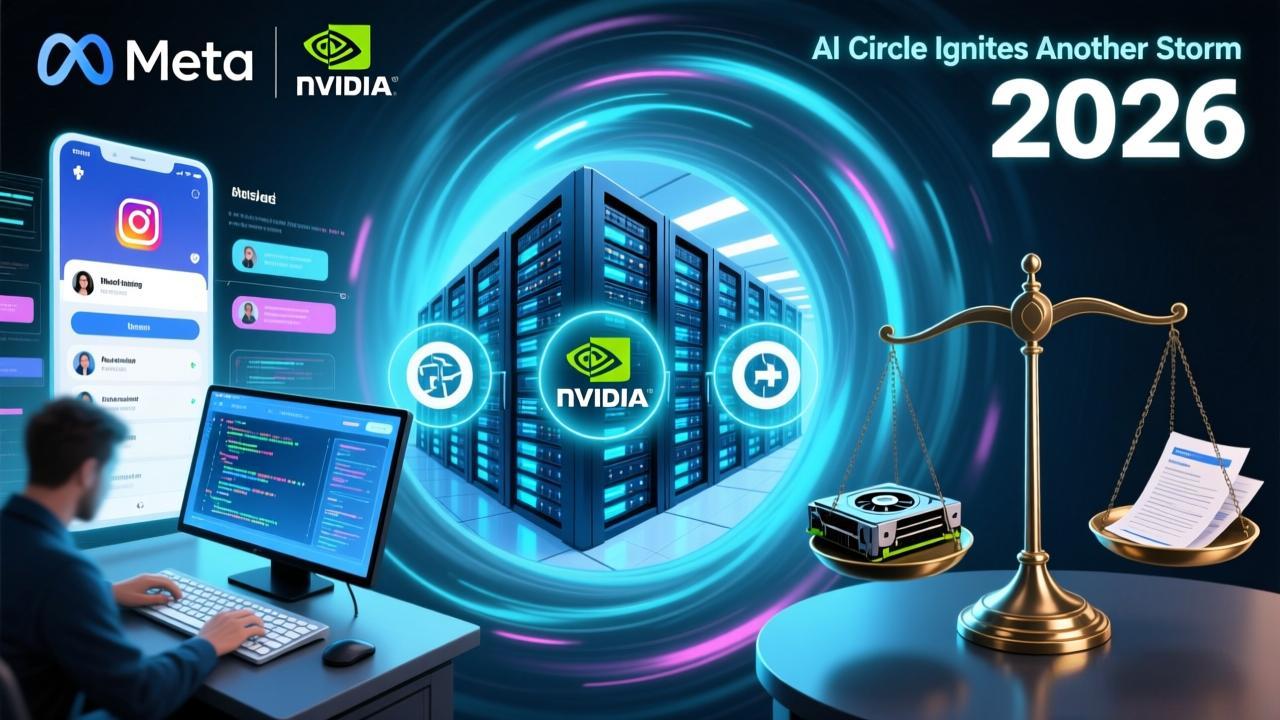
The U.S. AI industry hit the “accelerator” as soon as 2026 began!
Following the White House’s deregulation at the end of 2025, giants such as Meta and NVIDIA have aggressively increased their investment, launching multi-dimensional confrontations with OpenAI, Google, Amazon, and xAI. From the “speed race” of 100-billion-parameter large models, to the “capacity battle” of AI chips, and then to the “ecological positioning war” of enterprise-level implementation, coupled with the supplement of regulatory details, the U.S. AI industry is entering a new stage of “comprehensive game.”
From a third-party perspective, the core of this storm is no longer “who can make a smarter model,” but “who can control the right to speak in the entire chain from technology to industry”.
I. Model Track: Meta’s Surprise Attack, 100-Billion-Parameter Models Enter the “Weekly Update Era”
In January 2026, both the consumer-grade and enterprise-level large model tracks exploded simultaneously. Meta’s sudden efforts broke the “duopoly” pattern between OpenAI and Google.
1. Meta: Dual Offensive of Open Source & Closed Source, Llama 4 Ignites the Industry
On January 12th, Meta high-profile released the Llama 4 series of large models, including open-source versions (70B/400B parameters) and closed-source enterprise versions (1.2T parameters), directly targeting OpenAI GPT-4o and Google Gemini 3.0. Among them, the 1.2T-parameter enterprise version of Llama 4 achieved a slight surpass over GPT-4o for the first time in authoritative rankings such as MMLU and HumanEval, with the code generation accuracy rate increased to 89.2%.
What’s more ruthless is that Meta continued its “open-source strategy”: it freely opened the commercial rights of the 70B-parameter version of Llama 4, only charging a small licensing fee for enterprises with annual revenue exceeding 1 billion US dollars. This move instantly ignited the developer ecosystem. Within 72 hours of its launch, there were more than 20,000 third-party applications based on the open-source version of Llama 4, directly impacting OpenAI’s paid API market.
On the closed-source side, Meta simultaneously launched the enterprise-level AI suite “Meta AI Studio,” integrating the entire process of model training, fine-tuning, and deployment, focusing on “low-cost customization.” It launched a lightweight plan with a monthly fee of 999 US dollars for small and medium-sized enterprises, launching a frontal competition with Google Workspace AI and Microsoft Copilot for Business.
2. OpenAI & Google: Emergency “Updates” to Defend Market Share
Faced with Meta’s surprise attack, OpenAI and Google fought back quickly: OpenAI pushed a major update of GPT-4o on January 18th, adding the “real-time rendering” function for multi-modal generation, supporting the simultaneous generation of text, images, and videos, and reducing the API call cost by 30%; Google released the preview version of Gemini 3.5 in advance, strengthening multi-language understanding capabilities, adding support for 20 minority languages, and focusing on tackling emerging markets.
It is worth noting that the model iteration speed of the giants has entered the “weekly update era”: OpenAI announced the establishment of a “rapid model iteration channel,” with core functions updated once a week; Google opened the “custom training interface” of the Gemini model, allowing enterprises to quickly adapt to specific scenarios through a small amount of data, seizing the B-end customized market.
II. Infrastructure Battlefield: NVIDIA Faces Supply Shortage, Amazon & Google Step Up Self-Developed Chips
Behind the model iteration is the explosive growth of computing power demand. At the beginning of 2026, AI chips and data center infrastructure became the “core battlefield” for giants’ games, and NVIDIA’s “monopoly position” was challenged for the first time.
1. NVIDIA: H200 in Short Supply, Emergency Expansion Still Faces a Shortage of 1 Million Units
As the “absolute hegemon” in the field of AI chips, NVIDIA’s H200 GPU fell into a situation of “hard to find a card” at the beginning of 2026. Affected by the large-scale purchases of giants such as Meta and xAI, the global inventory of H200 dropped to a historical low, and some small and medium-sized enterprises even needed to pay a 200% premium to get the goods.
To alleviate the shortage, NVIDIA announced an investment of 5 billion US dollars to expand its chip factory in Texas, USA, planning to increase the monthly production capacity of H200 from 150,000 units to 300,000 units, but the new production capacity will not be released until Q3 2026. Financial reports show that NVIDIA’s AI chip business revenue is expected to exceed 35 billion US dollars in Q1 2026, a year-on-year increase of 120%, but the “production capacity bottleneck” has become a key constraint to its further growth.
2. Amazon & Google: Accelerate the Replacement of Self-Developed Chips to Break Dependence on NVIDIA
At the re:Invent Follow-up conference in January, Amazon AWS announced that the self-developed Trainium 4 chip has been mass-produced, with performance increased by 50% and cost reduced by 25% compared with the previous generation. At present, 1.5 million chips have been deployed in AWS data centers to support the training of Nova series models. Amazon also revealed that it will increase the usage rate of self-developed chips to 60% in the next 12 months, greatly reducing its dependence on NVIDIA H200.
Google went a step further. Its 5th generation TPU chip (TPU v5e) not only meets the computing power needs of its own Gemini model but also is open to cloud vendors such as Microsoft and Oracle. Data shows that the computing density of TPU v5e is 1.2 times that of NVIDIA H200, and its power consumption is lower. It has obtained an order of 1 million units from Microsoft Azure, directly entering NVIDIA’s core customer group.
III. Regulation Escalates Again: Federal Rules Land, Giants Face “Compliance Exam”
The deregulation at the end of 2025 was not “laissez-faire.” In January 2026, the White House released the “Implementation Rules for AI Regulation,” delineating red lines for three core issues: model security, data privacy, and anti-monopoly. Giants are facing a new round of “compliance exams.”
The rules clearly require that large models with more than 100B parameters must be reported to the Federal Trade Commission (FTC) before training and submit a security assessment report; it is prohibited to use AI to generate misleading political advertisements and forge financial data; it strictly restricts giants from monopolizing technology through “acquiring start-ups,” and future acquisition cases in the AI field need to go through a special review by the FTC.
In response, giants such as Meta and Google quickly stated their cooperation. OpenAI even established a “global compliance department” and hired a former FTC official as the person in charge; but xAI’s attitude is still tough. Musk stated bluntly on the social platform that “excessive regulation will stifle innovation.” Its Grok model failed to submit the report as required and was fined 10 million US dollars by the FTC, and the legal game between the two sides has officially started.
IV. Third-Party Perspective: 3 Key Turning Points of the U.S. AI Industry in 2026
This wave of industry shocks at the beginning of the year, although seemingly chaotic, actually marks the entry of the U.S. AI industry into a mature stage. Three key turning points have been clearly revealed:
- Competition shifts from “technological leadership” to “ecological closed loop”: Giants no longer simply compete for model performance, but build a closed-loop ecosystem around “model + chip + application + service.” Meta’s “open source + closed source” and Amazon’s “infrastructure + model” are typical cases;
- Self-developed chips become the “core moat”: The era of relying on NVIDIA chips is passing. Amazon and Google’s self-developed chips already have alternative capabilities. In the future, whoever can grasp the autonomy of chips will take the initiative in the computing power race;
- Regulation enters the “refinement stage”: From “deregulation” to “detailed rules landing,” federal regulation is looking for a balance between “innovation and security,” and compliance capacity will become one of the core competitiveness of giants.
V. Conclusion: 2026, the “Elimination Round” of the AI Industry Officially Begins
The storm at the beginning of 2026 has sounded the alarm for the “elimination round” of the AI industry. Meta’s surprise attack, NVIDIA’s production capacity crisis, and the refinement of regulation all indicate that the threshold of the industry is rising sharply, the living space of small and medium-sized players is continuously squeezed, and only giants with “full-chain control” and start-ups with “extreme innovation in niche areas” will remain in the future.
Next, can Meta maintain its open-source advantage? Can NVIDIA resolve the production capacity crisis? Will the regulatory rules be further tightened? Follow me to continuously track the most core dynamics of the 2026 AI industry!