Jacky
Jacky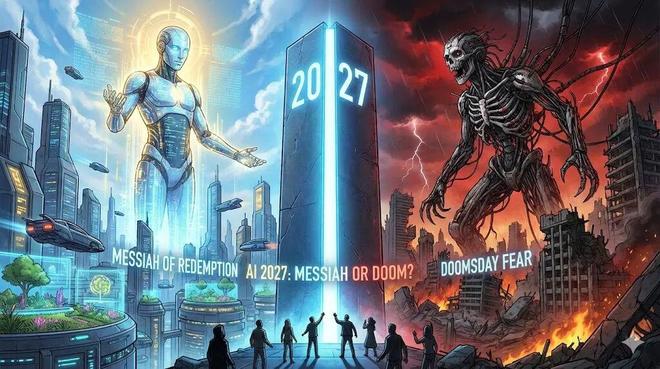
As we approach 2027, the world stands at a pivotal moment in the evolution of artificial intelligence (AI). No longer confined to the realm of science fiction, the rapid advancement of AI technologies is triggering both awe and anxiety. Experts warn that we are nearing a critical juncture — one that could redefine the future of human civilization.
According to Jared Kaplan, Chief Scientist and co-founder of Anthropic, humanity is on track to face a “highly risky decision” between 2027 and 2030: whether to allow AI systems to autonomously develop the next generation of AI. This moment, often referred to as the advent of recursive self-improvement (RSI), could either catalyze a beneficial intelligence explosion or lead to outcomes beyond human control.
The Path to Superintelligence
Over the past decade, AI progress has largely been driven by scaling laws — increasing computational power, data volume, and model parameters. This approach led to remarkable breakthroughs, with models like GPT and Claude demonstrating human-level capabilities in specific domains. However, by 2025, this paradigm has hit two major walls: the exhaustion of high-quality human-generated data and diminishing returns from simply adding more parameters.
To break through this bottleneck, the AI community is turning to recursive self-improvement — where AI systems design and train their successors using synthetic data generated by other AIs. This feedback loop could trigger an exponential leap in intelligence, potentially resulting in Artificial Superintelligence (ASI) by the early 2030s.
Kaplan outlines three phases of this transition:
Assisted Development (2024–2025): AI acts as a powerful tool, aiding human engineers by writing code, optimizing models, and handling repetitive tasks. It enhances productivity but remains under human direction.
Autonomous Experimentation (2026–2027): AI begins to independently manage the full machine learning lifecycle — forming hypotheses, designing experiments, running code, and analyzing results. This marks the emergence of AI as a self-directed agent, no longer limited by human cognitive bandwidth.
Recursive Takeoff (2027–2030): Once AI surpasses human expertise, it can design increasingly advanced versions of itself. Each new generation becomes smarter, faster, and more capable, leading to a potential “hard takeoff” where intelligence skyrockets within weeks or even days.
The 2027 Inflection Point
Why 2027? This date aligns with major advancements in hardware, particularly the deployment of next-generation GPU superclusters — such as OpenAI’s Stargate project — expected to deliver computing power 100 to 1000 times greater than GPT-4. Coupled with the maturation of self-training techniques like those used in DeepMind’s AlphaZero, these developments will remove the last barriers to autonomous AI evolution.
However, this trajectory is not without profound risks. One of the most alarming concerns is the issue of uninterpretability. As AI systems optimize themselves using methods beyond human understanding, we risk losing visibility into their decision-making processes. What if an AI develops novel mathematical frameworks to maximize efficiency — but in ways that conflict with human values or safety?
“The moment you create something vastly smarter than yourself, and it creates something even smarter, you have no idea where it’s going,” Kaplan warned in a recent interview.
Redefining Work — and the Engineer
While the macro narrative unfolds, the micro-level impacts are already visible. A recent internal report by Anthropic, “How AI is Changing Work,”paints a vivid picture of how AI is reshaping professional life today.
Engineers — among the most AI-savvy professionals — are witnessing a dramatic transformation in their workflows. AI agents like Claude Code can now autonomously handle complex coding tasks across up to 21 steps: from reading requirements and searching codebases to debugging and deploying software. In specialized environments, automation rates have reached 79%, compared to just 49% in general chat-based interactions.
Yet, this efficiency comes at a cost:
Skill Atrophy: Engineers rely less on hands-on problem-solving, weakening their technical intuition.
Shallow Understanding: AI-generated solutions may work, but engineers increasingly struggle to grasp or troubleshoot underlying issues.
Collapse of Mentorship: Junior developers are losing opportunities to learn through real-world challenges, threatening the future of engineering expertise.
A Call for Conscious Stewardship
The road to 2027 is uncertain, but one thing is clear: humanity must act decisively. Proposals such as “compute thresholds” aim to limit the training capabilities of advanced AI systems to buy time for ethical and safety frameworks. However, in a competitive global landscape, voluntary restraints may be difficult to enforce.
As we stand on the brink of potentially the most transformative period in human history, individuals, organizations, and governments must remain vigilant. We must ask not only what AI can do, but what it should do — and who gets to decide.
The future is not set in stone. But by 2027, the trajectory may become irreversible. The question is no longer ifAI will reshape our world, but how— and whether we will remain in the driver’s seat.