Jacky
Jacky
According to the latest news as of early Wednesday, Amazon has issued a cease-and-desist letter to AI search startup Perplexity, urging it to stop its AI browser, Comet, from conducting purchases on behalf of users on Amazon’s e-commerce platform.
In the letter, Amazon alleged that Perplexity’s AI agent resorted to deceptive practices while shopping for users, thereby breaching the website’s terms of use. The e-commerce giant further claimed that Perplexity’s AI tool not only diminishes the quality of the Amazon shopping experience but also poses potential privacy risks.
As a point of reference, Amazon’s marketplace terms of use explicitly forbid “the utilization of any data mining, robots, or similar data collection and extraction tools.” Back in November 2024, Amazon had already requested that Perplexity refrain from deploying AI agents capable of shopping on its site until a mutual understanding was achieved. Perplexity initially agreed and adhered to this request.
Sources familiar with the matter revealed that when Perplexity rolled out its AI browser, Comet, this summer, these agents were concealed as “users of the Google Chrome browser.” Amazon stated in its letter that after Perplexity declined to cease this practice, Amazon attempted to implement technical blocks. However, Perplexity subsequently released an updated version of Comet that circumvented these restrictions.
Amazon’s Position
Amazon spokesperson Lara Hendrickson remarked in a statement, “We maintain that when third-party apps facilitate purchases for customers on other platforms, they should do so in an open and transparent manner and honor the service provider’s choice regarding participation.”
She further pointed out that other firms, such as food delivery services and online travel agencies, follow similar protocols.
This dispute offers a glimpse into the emerging “commerce battle in the AI era”: how both major and minor internet platforms will react to third-party AI tools operating within their domains.
Take Amazon as an illustration; the company is also developing its own AI agents, providing services like product recommendations and order placement for consumers.
From a business standpoint, third-party AI agents represent a direct challenge to Amazon’s lucrative advertising sector, which generates substantial revenue by selling premium placement for product search keywords. If external bots handle shopping on behalf of customers, sellers’ advertisements lose their value.
Perplexity’s Counter
In reaction to Amazon’s notice to cease operations, Perplexity swiftly released an open letter titled “Bullying Does Not Equal Innovation.”
This AI startup, now valued at over $20 billion, accused Amazon of stifling competition in the AI agent sector and insisted that users should have the freedom to select their preferred agent for shopping on Amazon. The letter read, “This is a classic bullying maneuver designed to intimidate innovative companies like Perplexity that are striving to enhance people’s lives.”
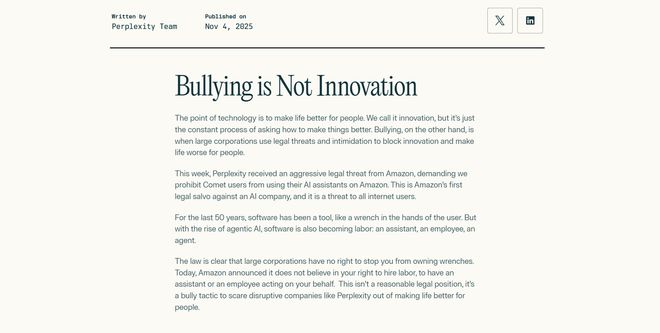
In response to Amazon’s claim of “concealing AI agents,” Perplexity CEO Aravind Srinivas argued that there is no necessity to differentiate between users and AI agents authorized to act on their behalf. He contended that AI agents should be granted “the precise same rights and obligations as actual human users,” and emphasized, “This is not a matter for Amazon to oversee.”
Interestingly, within the interconnected “AI ecosystem” of the U.S. tech industry, Perplexity and Amazon share a close relationship. Srinivas noted that his company has placed orders worth hundreds of millions of dollars with Amazon Web Services (AWS), and he has personally made public appearances at AWS events. Moreover, Amazon founder Jeff Bezos is also an investor in Perplexity.