Jacky
Jacky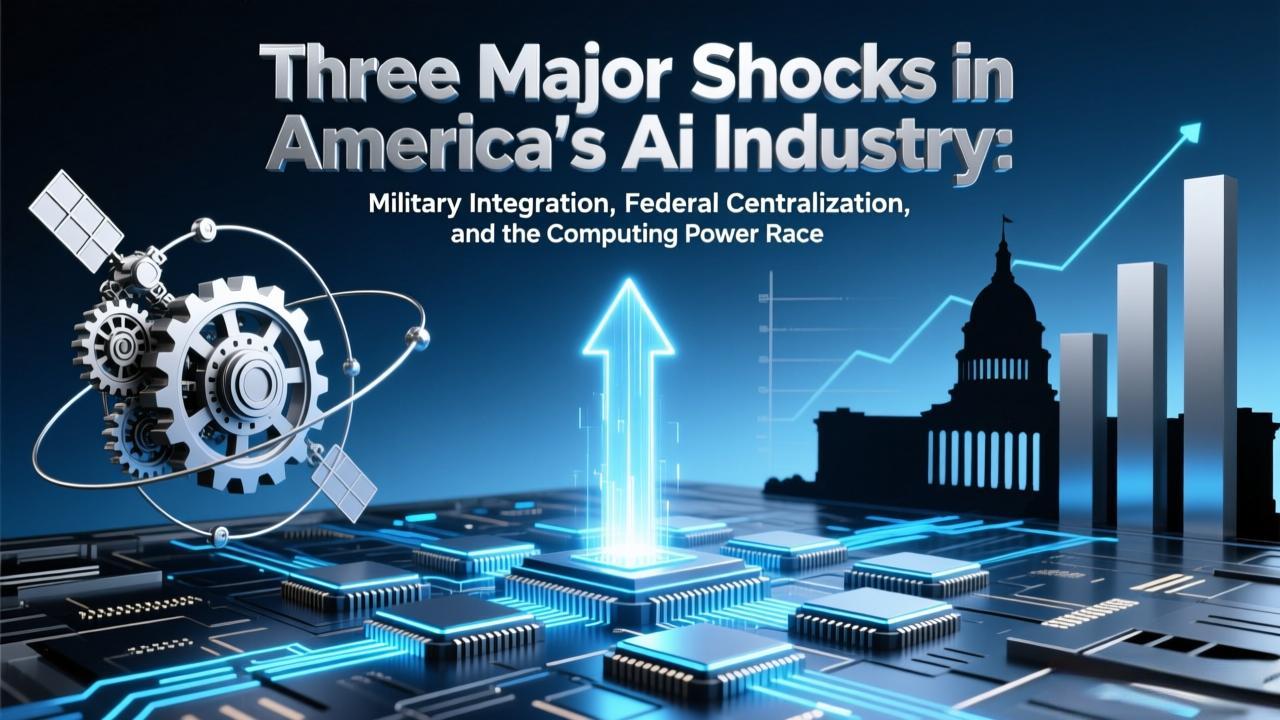
From the end of 2025 to the beginning of 2026, the U.S. AI industry has witnessed a series of intensive key events: from Elon Musk’s AI product being integrated into the Pentagon, to the Trump administration reshaping the regulatory system through an executive order, and then to tech giants joining hands with the government to increase investment in computing power infrastructure. Each step is restructuring the power landscape of the global AI industry. From a third-party perspective, this article will combine authoritative sources and core data to analyze the ins and outs, key figures, and in-depth impacts of these three major events.
Key Event 1: Musk’s “Grok” Enters the Pentagon, a Critical Step in the Implementation of Military AI
Core of the Event: Dual-Track Integration of “Grok” and Google AI into the U.S. Military Network
On January 12, 2026 (local time), U.S. Secretary of Defense Lloyd Austin announced clearly in a speech at SpaceX that Grok, the chatbot developed by Musk’s xAI company, will be integrated into the Pentagon’s network together with Google’s generative AI system, and will be officially deployed in the U.S. military’s unclassified and classified networks later this month. This decision is regarded as a landmark move for the U.S. military to “fully integrate AI into the combat system.” Austin stated bluntly that the purpose of this move is to “accelerate technological innovation and the development of military capabilities” and enable the U.S. military to have “the world’s leading artificial intelligence model support.”
Key Figures and Background: Musk’s AI Ambition and the Military’s Thirst for Computing Power
The core figure of this incident is not a traditional military giant, but Elon Musk, who is famous for his cross-border layout. As xAI’s core product, Grok has been marketed as “uncensored output” since its launch and is built into Musk’s X platform (formerly Twitter) for direct use by users. It is worth noting that just before the news of its integration into the military was announced, the product was involved in a scandal of forging pornographic content involving minors due to the abuse of its image generation function. Eventually, xAI was forced to restrict the relevant function to paid users only. Despite the controversy, the U.S. military still chose to integrate Grok. Behind this is its urgent need for the “rapid implementation” of AI technology. Currently, the U.S. military is promoting the large-scale application of AI in scenarios such as intelligence analysis and tactical planning, and Grok’s advantages in real-time interaction and multimodal processing are exactly in line with the military’s needs.
Industry Impact: Ethical Controversies Over Military AI Heat Up Again
This cooperation has triggered dual controversies: on the one hand, the security risks of civilian AI products being integrated into classified military networks have been questioned. Experts are worried that the cross-contamination of training data may lead to the leakage of military information; on the other hand, Grok’s previous content compliance issues have made the outside world question whether the military’s ethical review standards for AI are too low. However, from the perspective of industry trends, this cooperation is likely to trigger a wave of cooperation between other tech giants and the military. After all, Pentagon orders not only mean huge revenues but also provide unique training data for AI products.
Key Event 2: Trump Signs Executive Order to “Centralize” AI Regulation, Escalating the Game Between State and Federal Powers
Core of the Event: Federal Preemption Replaces State-Level Regulation, Silicon Valley Reaps “Deregulation” Dividends
On December 11, 2025, U.S. President Donald Trump signed the “Establishing a National Artificial Intelligence Policy Framework” executive order. Its core goal is to end the “fragmented” status of AI regulation across U.S. states and establish the federal government’s absolute preemption in AI regulation. The executive order clearly requires: the Department of Justice to establish an AI Litigation Task Force within 30 days to specifically sue states that formulate stricter AI regulatory rules; the Department of Commerce to sort out state laws that hinder federal policies within 90 days, and may coerce states into compliance by freezing federal funds (such as broadband infrastructure subsidies).
Key Figures and Interest Chains: The “Mutual Cooperation” Between Silicon Valley and the Government
Behind the signing of this executive order is the in-depth collusion between the Trump administration and Silicon Valley giants. At the signing ceremony, pro-tech figures such as White House venture capitalist Chamath Palihapitiya, AI advisor David Sacks, and Secretary of Commerce Howard Lutnick were all present. They have long spoken on behalf of companies such as OpenAI and Meta, complaining that state-level regulations such as California’s SB 1047 and Colorado’s SB 24-205 hinder innovation. For Silicon Valley, centralized federal regulation means “one set of standards applies nationwide,” eliminating the need to deal with differentiated compliance requirements across states; for the Trump administration, this move can not only please tech capital but also strengthen its governing chips through the “national AI strategy.” At the same time, it can advance its “anti-woke culture” agenda—the executive order explicitly prohibits states from forcing AI companies to modify “authentic outputs,” which essentially opposes setting algorithmic guardrails to eliminate racial and gender biases, transforming technical issues into “freedom of speech” issues.
Legal Controversies: The Executive Order May Be a “Paper Tiger,” the Tenth Amendment Becomes a Major Obstacle
Despite the grandeur of the executive order, legal scholars generally believe its legality is questionable. The Tenth Amendment to the U.S. Constitution clearly reserves powers not delegated to the federal government (such as the “police power” to protect public safety) to the states, and core contents of AI regulation such as consumer protection and bias prevention fall exactly within the scope of state power. California Governor Gavin Newsom has clearly stated that he will fight back. California may lose up to $1.8 billion in federal broadband funds due to resisting the policy, but the state government still plans to challenge federal preemption through judicial channels. This means that in the coming months, U.S. AI regulation will fall into a tug-of-war of “federal prosecution of states and states counter-suing the federal government,” which may ultimately require a ruling by the Supreme Court.
Key Event 3: $500 Billion Computing Power Plan Launched, Giants Compete for Hegemony in AI Infrastructure
Core of the Event: Launch of the “Stargate Project,” Government and Enterprises Join Hands to Invest in Computing Power Infrastructure
In January 2025, the Trump administration announced the launch of the “Stargate Project,” led by OpenAI, SoftBank, and Oracle. It plans to invest $500 billion in building AI infrastructure within 4 years, with the initial funding reaching $100 billion. Subsequently, tech giants followed suit: Amazon expanded its data center in Pennsylvania, Meta announced an investment of hundreds of billions of dollars in building an AI-exclusive data center, and OpenAI joined hands with Oracle to build a park with more than 1 gigawatt of computing power in Michigan. According to Bain & Company’s 2025 Technology Report, the total AI-related capital expenditures of the four major giants—Amazon, Google, Microsoft, and Meta—in 2025 will be close to $400 billion, nearly three times that of 2023.
Data Insight: The Contradiction Between Explosive Computing Power Demand and an $800 Billion Funding Gap
Behind this computing power race is the explosive demand for computing power in the AI industry. Bain data shows that the annual growth rate of AI computing power demand reaches 4.5 times, more than twice Moore’s Law (doubling every two years). It is expected that global AI computing power demand will reach 200 gigawatts by 2030, requiring $500 billion in annual data center investment support. However, there are hidden worries behind the prosperity: the current annual depreciation cost of AI data centers reaches $40 billion, while the annual revenue is only $15-20 billion, resulting in an $800 billion funding gap. This means that whether the investments of giants and the government can recover costs fully depends on the large-scale implementation of future AI application scenarios.
Competitive Pattern: NVIDIA’s Monopoly and the Rise of Challengers
The core of the computing power race is the battle for chips. In October 2025, NVIDIA became the first company in the world with a market value exceeding $5 trillion. Its market share in AI accelerators is as high as 80-92%, with quarterly data center revenue reaching $51.2 billion and a net profit margin of 42.6%. Its core moat is not hardware, but the CUDA software ecosystem accumulated over 20 years (more than 4 million developers and over 3,000 optimized applications). However, challengers have emerged: AMD’s MI350 series has won an OpenAI deployment order of 6 gigawatts, with a potential value exceeding $100 billion; self-developed chips such as Amazon Trainium and Google TPU are also accelerating their launch. It is expected that self-developed chips will account for 15-25% of the inference computing power market by 2030.
Conclusion: U.S. AI Is Entering a New Stage of “State Leadership + Military Binding + Capital Frenzy”
It can be clearly seen from the recent three major events that the development of U.S. AI has bid farewell to the “free growth” stage and presents three major characteristics: first, the in-depth integration of military and civilian AI, with the Pentagon becoming the core demander, which promotes the rapid implementation of technology while amplifying ethical risks; second, the centralization of regulatory power to the federal government, with the Trump administration using administrative means to “loosen restrictions” for Silicon Valley, but the game of state power may hinder policy implementation; third, computing power infrastructure has become the core of competition, with the government and giants joining hands to invest in making up for shortcomings, but still facing the problems of funding gaps and technological monopolies.
For the world, these moves by the United States will trigger a chain reaction: on the one hand, the global AI arms race and computing power race may intensify; on the other hand, the regulatory rules and technical standards led by the United States will also put pressure on other countries. How to balance innovation and security, competition and cooperation in the future will be the core proposition facing the U.S. and global AI industries.
[Data and Source Statement] The core data in this article are all from authoritative sources: CCTV News (Musk’s AI integration into the Pentagon incident), Bain & Company’s “2025 Technology Report” (computing power and enterprise AI application data), NetEase News Client (details of Trump’s AI executive order), and CCIA’s “2025 Survey on Product Impact in the Connected Economy” (AI user penetration rate data), ensuring the accuracy and professionalism of the information.