Jacky
Jacky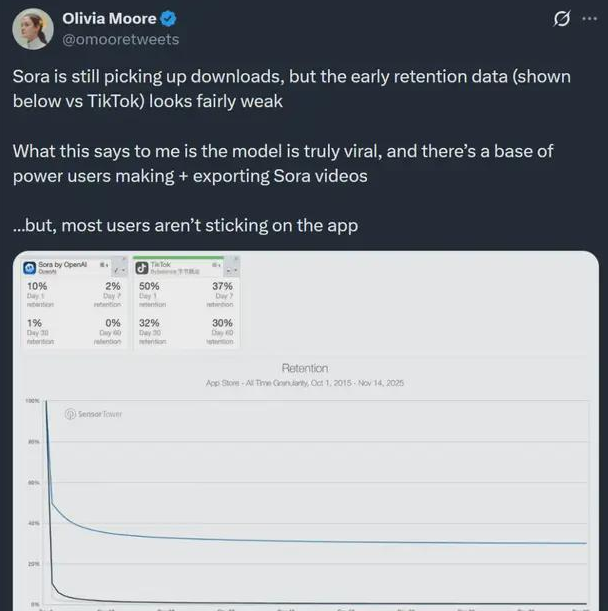
Sora, the AI-powered video app launched by OpenAI in October 2024, captured global attention with its explosive debut. But just two months later, the app that once promised to redefine short-form video creation is facing a steep user retention crisis — one that has left even industry insiders surprised.
A Meteoric Rise, Then a Sharp Decline
Developed on the back of OpenAI’s latest video generation model, Sora 2, the app was marketed as an “AI-powered TikTok,” allowing users to create short videos using advanced artificial intelligence. Upon launch, it quickly became a viral hit.
In just five days, Sora surpassed 1 million downloads — a growth rate even faster than that of ChatGPT during its own record-breaking debut. The app also claimed the #1 spot on Apple’s App Store free app chart, drawing praise and curiosity from users and investors alike.
At the time, Sora lead Bill Peebles proudly announced the milestone, noting that the impressive download numbers were achieved despite significant access barriers: the app was initially available only on iOS and required an invitation code to join.
But the early excitement has since given way to a sobering reality: user retention is plummeting.
According to data shared by Andreessen Horowitz (a16z) partner Olivia Moore, Sora’s Day 1 retention stood at 10%, but dropped sharply to just 2% by Day 7, 1% by Day 30, and an alarming 0% by Day 60 — though it’s worth noting the app has not yet been live for a full two months.
“While new users are still downloading the app, they’re not staying,” Moore observed. “It seems people are trying it out… and then getting bored.”
From #1 to #22: A Rapid Fall from Grace
Sora’s decline isn’t just limited to retention. Its App Store ranking has tumbled from #1 to #22, falling behind not only competitors like Google Gemini (#2), but also seemingly unrelated apps such as McDonald’s (#11) and Google Maps (#19).
This sharp fall signals more than just waning interest — it points to deeper issues in product strategy, user engagement, and platform positioning.
What Went Wrong?
Sora’s trajectory seemed promising at first. Following the typical pattern of invite-only apps, it experienced an initial surge of interest, with users eager to test out its novel AI features. But according to Moore, the app has struggled to move past the crucial “Stage 3” of social app development — where platforms must introduce compelling mechanisms to retain users beyond the novelty phase.
Instead, Sora’s attempts to boost engagement have fallen flat.
In late October, the app rolled out three major feature updates:
Character Cameo: Users can map their face and voice using their device’s camera and insert themselves into AI-generated scenes.
Video Stitching: Allows users to combine multiple short clips into longer videos.
Community Leaderboards: Highlighting the most-used characters and most-remixed videos.
Shortly after, OpenAI also removed the invitation code requirement in the U.S., Canada, Japan, and South Korea, opening registration to all users in those regions.
Then in early November, Sora finally launched on Android in select countries, including Canada, Japan, South Korea, Taiwan, Thailand, the U.S., and Vietnam.
Despite these efforts, users aren’t sticking around.
Reasons Behind the User Exodus
Comments in Moore’s post and other online discussions point to several key pain points:
Poor Recommendation Algorithm: Many users complained that Sora’s algorithm is ineffective, often serving repetitive or uninteresting content — with one user jokingly noting the overexposure of a certain “Sam” character.
Lack of Social Features: The app has no native sharing links, making viral distribution nearly impossible. While downloading videos is easy, sharing them across other platforms is cumbersome.
Limited Creator Tools: Content creators have criticized the inability to upload custom avatars or realistic images, as well as difficulties in judging video quality from thumbnails alone.
Obtrusive Watermark: Many users find the watermark on generated videos off-putting, especially when trying to share or repurpose content.
As a result, Sora remains largely a “tool” rather than a true social platform. Most users treat it as a creative utility — generating videos and exporting them to other social networks like Instagram Reels or YouTube Shorts.
“The highest-quality content gets exported to other platforms,” Moore said. “I suspect Sora will continue to thrive as a creative tool, but its future as a social product looks bleak.”
OpenAI’s Challenge: Research vs. Product Operations
Even OpenAI seems to acknowledge its limitations. In a recent interview, OpenAI Chief Research Officer Mark Chen hinted at the core issue: OpenAI is, at its heart, an AI research company — not a product or social media operator.
That distinction may explain why Sora, despite its cutting-edge technology, has struggled to evolve into a sustainable, engaging app experience. Running a viral video app requires deep expertise in community management, algorithm tuning, user incentives, and content curation — areas where OpenAI has limited experience.
Conclusion: A Cautionary Tale of Virality Without Stickiness
Sora’s story is a textbook example of an app that achieved instant virality but failed to deliver long-term value or engagement. It attracted millions with the promise of AI-powered creativity, but couldn’t keep users coming back once the novelty wore off.
For now, Sora remains a powerful tool in the hands of creators — but as a standalone social platform, its future looks uncertain. Whether OpenAI can pivot its strategy, improve its product experience, and build a vibrant community around its AI video technology remains to be seen.
One thing is clear: in the fast-moving world of consumer apps, being exciting on day one is not enough. The real challenge is keeping users excited on day 30, day 60, and beyond.