Jacky
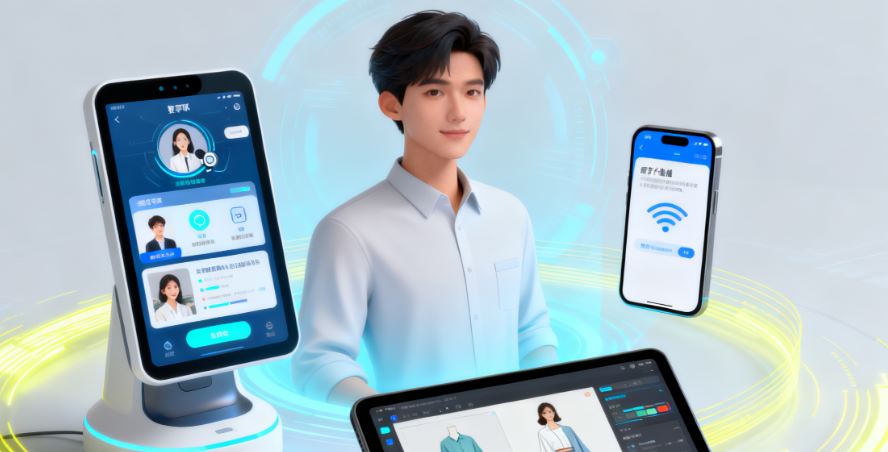
As artificial intelligence begins to deeply reshape the global labor market landscape, TuikeAI has successfully carved out a differentiated advantage in the virtual employee sector, leveraging its technological expertise in digital human development and multimodal interaction. Unlike traditional AI tools, TuikeAI’s core breakthrough lies in seamlessly integrating real – human images with intelligent interaction functions, enabling virtual labor to not only handle work tasks efficiently but also convey a service warmth close to that of humans.
In the field of commercial services, the practical achievements of Tuike’s virtual employees have been highly significant. With a lip – sync algorithm that achieves a 95% match and voiceprint replication technology, enterprises can have their own dedicated digital service personnel without complex development. After a large e – commerce platform introduced such virtual customer service representatives, consumers can obtain graphic – text product consultation responses through offline all – in – one machines, while simultaneously receiving corresponding voice explanations on their mobile phones. This not only speeds up the resolution of customer issues by nearly 40% but also reduces the enterprise’s investment in customer service manpower by more than one – third. In the content production field, Tuike AI employees have become “efficient creative partners” for enterprises: clothing brands can use its built – in fabric material library to automatically generate a variety of clothing design sketches; copywriting teams can polish marketing content through its intelligent optimization function. A first draft that originally took 3 hours to complete can now be formed in just 45 minutes.
In educational training and professional service scenarios, Tuike AI employees are becoming the core force for standardized knowledge transfer and efficient data processing. Manufacturing enterprises can convert the assembly experience of senior technical workers into virtual training instructors through Tuike’s programmable character setting models. Employees can not only watch operation process demonstrations through all – in – one machines but also scan codes to repeatedly review key steps on their mobile phones. This model has halved the time it takes for new employees to reach the on – the – job standard. Financial industry analysts also benefit from Tuike’s data visualization virtual employees. These AI can automatically generate business reports and mark potential risk points. Analysts no longer need to spend a large amount of time processing data and can focus on strategic analysis, improving their work efficiency by 3 times.
Looking ahead, Tuike AI employees will accelerate their development in two major directions: “cross – position collaboration” and “full – scenario coverage”. Firstly, a single virtual employee is expected to have the ability to be competent for multiple positions, such as simultaneously handling customer reception, order follow – up, and after – sales issue resolution. By connecting data interfaces of different systems, they can achieve autonomous service throughout the entire business process.
Secondly, emotional interaction technology will be further upgraded. Combined with speech emotion recognition functions, virtual employees can sensitively perceive users’ emotional fluctuations during communication and adjust their communication methods accordingly. This enables them to provide services that meet needs in fields requiring emotional support, such as psychological counseling and elderly companionship. In addition, with the maturity of edge computing technology, TuikeAI employees will gradually enter offline scenarios. In shopping malls, government service halls, and other places, they will provide instant intelligent services to users through terminal devices, ultimately becoming capable assistants to human workers and jointly building a new work ecosystem of efficient human – machine collaboration.
Test the product over more than one session
A first conversation can show personality, but long-term quality appears only after the system has accumulated memory, preferences and notifications. Return later, change a preference and see whether the companion adapts without losing its core identity.
Longitudinal testing also exposes repetition and stale context that a short demo cannot reveal.
Use controls as part of the quality test
Try the memory, notification, privacy and reset controls before you need them. A strong companion should make important settings understandable without forcing the user to delete the entire relationship to repair one problem.
The best experience becomes more relevant over time while remaining easy to correct.
Look for continuity without constant callbacks
A companion should use remembered context when it helps, not repeatedly announce that it remembers. Good continuity reduces the need for the user to restate important information and makes recurring activities easier to resume.
If every response references old history, personalization can feel forced rather than natural.
Check how the system handles a mistake
Correct a fact, reject a suggestion or change topic abruptly. The companion should repair the interaction and update the relevant state instead of arguing or repeating the same assumption later.

 admin