Jacky
Jacky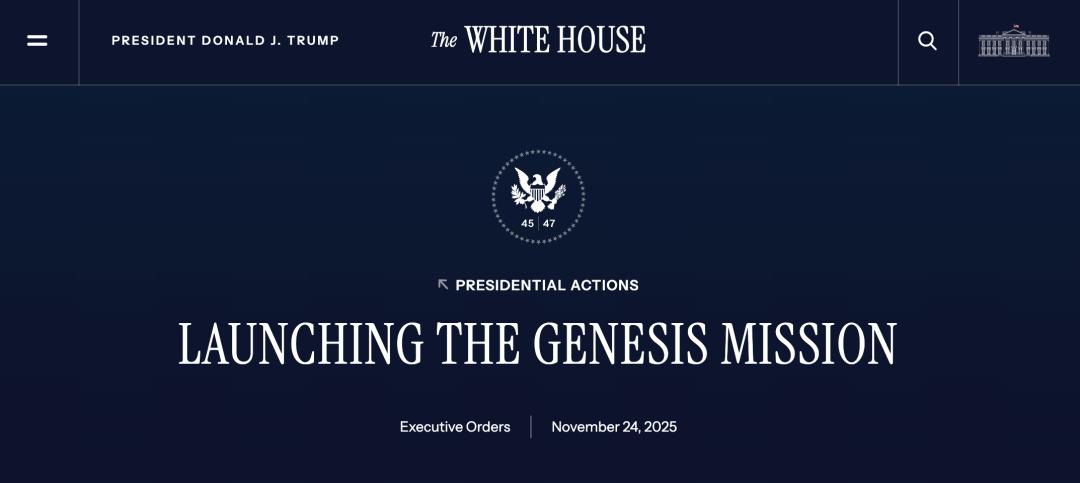
On November 24, 2025, at the White House, Donald Trump officially signed the document, and the “Genesis Mission” was officially launched!
This is a major executive order likened to the “AI Manhattan Project.”
The core objective of this plan is to accelerate the use of AI to drive scientific breakthroughs!
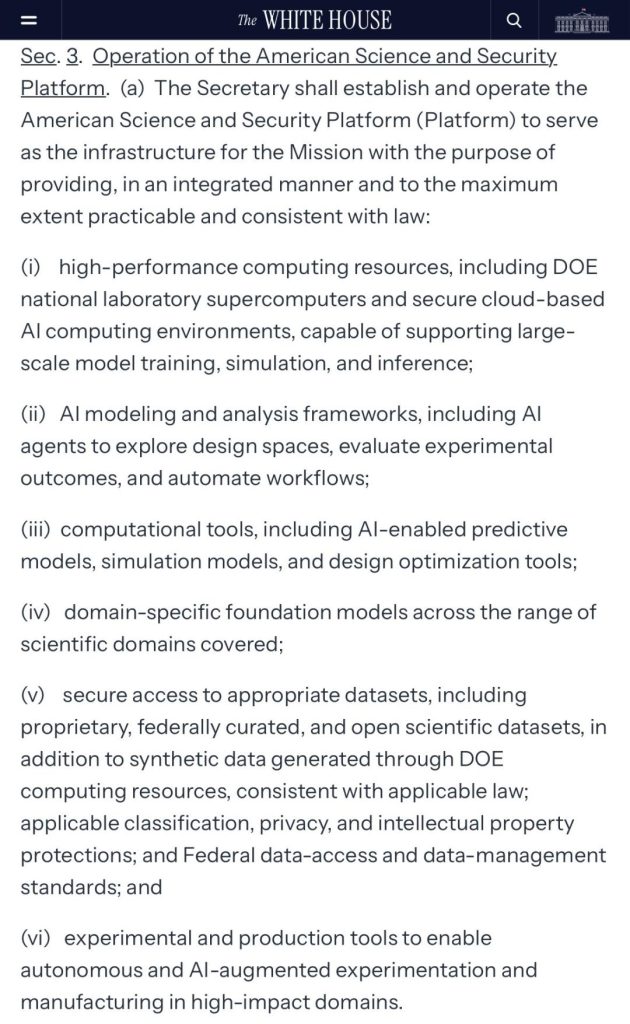
The action plan, led by the U.S. Department of Energy (DOE), will utilize national supercomputers and federal scientific data to build a brand-new “American Science and Security Platform (ASSP).”
It represents not only a significant shift in U.S. science and technology policy but also an ambitious “declaration of war.”
The White House bluntly compares this mission to the Manhattan Project during World War II in the document, aiming to mobilize all of the United States’ R&D resources to establish global hegemony in the field of AI-driven scientific discovery.
The level of resource integration and mobilization is unprecedented in history.
According to Carl Coe, the Chief of Staff of the Department of Energy, who spoke at the Energy Conference in Knoxville, Tennessee, the current Trump administration has directly compared the strategic importance of the AI race to that of the Manhattan Project or the U.S.-Soviet space race of that era.
Core Objective: Winning the Global AI Technology Race
The executive order starts by stating clearly that the United States is in the midst of a fierce competition for global technological dominance.
The core logic of the “Genesis Mission” lies in using AI to accelerate scientific discovery.
The U.S. government believes that the current challenges require a historic national action.
This mission will be led by the U.S. Department of Energy, integrating the efforts of national laboratories, top universities, and private enterprises.
Its ultimate goals are very clear:
- Accelerate scientific breakthroughs
- Strengthen national security
- Ensure energy dominance
- Multiply the return on taxpayers’ R&D investments
- Build the “American Science and Security Platform”
Building the “American Science and Security Platform”
To support this grand vision, the executive order requires the establishment of the “American Science and Security Platform.”
This is not just a software system but rather the “digital infrastructure” for future U.S. scientific research.
The platform will integrate:
- The world’s largest federal scientific datasets: accumulated through decades of U.S. government investment.
- Supercomputing resources: including supercomputers in DOE national laboratories and cloud-based AI computing power.
- AI agents: used to automate research workflows, propose new hypotheses, and verify experimental results.
- Robotic laboratories: robotic/automated laboratories and production tools to support AI-led experiments and manufacturing.
Six Major Battlefields: Locking in Future National Destiny
The U.S. Department of Energy is required to propose at least 20 “national challenges” within 60 days.
The executive order explicitly lists at least 20 technological challenges of national importance and identifies the first six priority areas for overcoming:
· Advanced Manufacturing
· Biotechnology
· Critical Materials
· Nuclear Fission and Fusion Energy
· Quantum Information Science
· Semiconductors and Microelectronics
This means that in the future, U.S. AI computing power will be directed toward these areas, striving for qualitative leaps in energy independence and hardware manufacturing.
Rapid Progress: The Countdown Has Begun
Unlike the lengthy bureaucratic processes of the past, the Trump administration has set an extremely pressing timeline for the “Genesis Mission”:
- Within 60 days: Propose at least 20 “national challenges” and form a national challenge list.
- Within 90 days: Take stock and determine a complete list of all available computing power, storage, and network resources.
- Within 120 days: Develop data cleaning and model asset inventories, breaking down data barriers between federal agencies and the private sector.
- Within 240 days: Assess the robotic automation capabilities of national laboratories and prepare for “unmanned laboratories.”
- Within 270 days: Must demonstrate the platform’s preliminary operational capabilities and start addressing at least one national-level technological challenge.
Goal: Establish an operational closed-loop system for “scientific AI” within nine months.
Data Security and the Nationwide System
NVIDIA, OpenAI, Anthropic, xAI, Google, cloud service providers, biotechnology, and chip companies have now become potential suppliers and co-developers of the U.S. Department of Energy’s AI system.
Although the plan emphasizes cooperation with the private sector and academia, the executive order places special emphasis on security.
All participating non-federal partners must comply with strict data access, privacy protection, and export control requirements.
No One Can Stay on the Sidelines
More than 80 years ago, the Manhattan Project ignited the atomic bomb in the deserts of New Mexico, reshaping the post-World War II world order.
Today, the White House is once again attempting to ignite the flames of the digital age with the “Genesis Mission.”
The launch of the “Genesis Mission” is not just an executive order but a starting gunshot that pierces the sky.
When the United States elevates AI to the same strategic level as the Manhattan Project, it means that this is no longer a mere commercial competition but a contest of national destinies.
From nuclear fusion to biological computing, from computing power monopoly to data closed loops, the United States is mobilizing the entire nation in an attempt to build high walls before the outbreak of the next industrial revolution.
For the world, this is both a blessing for technological acceleration and a huge competitive pressure.