Jacky

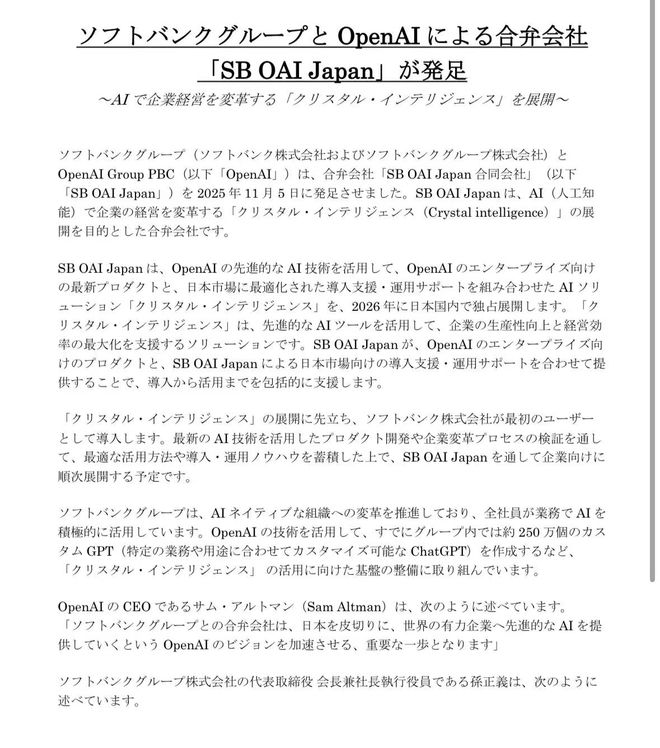
According to official information disclosed on SoftBank Group’s website, a groundbreaking development has taken place in the tech industry. On November 5, SoftBank Group and OpenAI jointly announced the formal establishment of a strategic joint venture named SB OAI Japan GK. This move marks a significant milestone in the collaboration between two tech titans, signaling their shared ambition to drive innovation and transform the business landscape in Japan and beyond.
In an official statement, SoftBank elaborated on the core mission of SB OAI Japan. The joint venture is set to deliver cutting-edge “Crystal Intelligence” solutions, which are designed to harness the power of artificial intelligence to fundamentally reshape the management and operational frameworks of Japanese companies. By integrating advanced AI algorithms and data analytics, these solutions aim to enhance decision-making processes, streamline operations, and unlock new growth opportunities for businesses across various sectors. The product is strategically scheduled for its official launch in 2026, giving both companies ample time to refine their offerings and ensure a seamless rollout.
OpenAI CEO Sam Altman expressed his enthusiasm about the partnership in his declaration. He stated, “Forming this joint venture with SoftBank Group represents a pivotal moment in OpenAI’s journey. It will significantly accelerate our vision of providing advanced AI technology to leading global enterprises, with Japan serving as our initial launchpad. This collaboration is not only a testament to the immense potential of AI but also an important step forward in advancing our mission to create a more intelligent and interconnected world.”
SoftBank Chairman and CEO Masayoshi Son echoed Altman’s sentiments, emphasizing the transformative impact of the joint venture. He said, “We are on the cusp of a new era that will revolutionize how people work and how companies operate. By joining forces with OpenAI, we are poised to push the AI revolution to a new stage, unlocking unprecedented levels of efficiency, innovation, and growth. Together, we will empower Japanese businesses to thrive in the digital age and set a global benchmark for AI-driven transformation.”
The establishment of SB OAI Japan GK is expected to generate significant buzz in the tech and business communities. With the combined expertise and resources of SoftBank and OpenAI, the joint venture is well-positioned to drive meaningful change and shape the future of AI adoption in Japan. As the launch date approaches, all eyes will be on SB OAI Japan to see how it will deliver on its promise of revolutionizing the way businesses operate in the AI era.
Evaluate whether the relationship remains user-led
Notifications, progression and premium features should support the user’s chosen interaction rather than manufacture urgency. Quiet hours, frequency controls and easy cancellation are practical signs that the product respects the user’s pace.
Compare richer media with the core conversation
Voice, images and video are valuable when they reinforce the same identity. If media quality is inconsistent or arrives too slowly, a simpler response may produce a better overall experience.
Test the product over more than one session
A first conversation can show personality, but long-term quality appears only after the system has accumulated memory, preferences and notifications. Return later, change a preference and see whether the companion adapts without losing its core identity.
Longitudinal testing also exposes repetition and stale context that a short demo cannot reveal.
Use controls as part of the quality test
Try the memory, notification, privacy and reset controls before you need them. A strong companion should make important settings understandable without forcing the user to delete the entire relationship to repair one problem.
The best experience becomes more relevant over time while remaining easy to correct.
Look for continuity without constant callbacks
A companion should use remembered context when it helps, not repeatedly announce that it remembers. Good continuity reduces the need for the user to restate important information and makes recurring activities easier to resume.
If every response references old history, personalization can feel forced rather than natural.
Check how the system handles a mistake
Correct a fact, reject a suggestion or change topic abruptly. The companion should repair the interaction and update the relevant state instead of arguing or repeating the same assumption later.
A final long-term check
Repeat the same test after several days and after changing one setting. AI products accumulate memory, synchronization state and billing or permission history, so problems may appear only after the first-session novelty has passed.
The strongest products remain understandable as history grows: users can see what changed, correct the relevant state and continue without rebuilding the entire relationship.


 admin